



Xochitl Maykovich: This is Xochitl from our Seattle. You’re listening to KHUH-LP 104.9 FM Seattle.
nfz: This podcast is episode one in a new series inspired by the Block the Shot campaign, endorsed by organizations like Our Seattle and Community Not Cameras. Throughout, there will be context clips sampled from outside sources, as well as editorial voiceovers for things like quotes from written sources.
Seattle’s new mayor, Katie Wilson, has recently found herself in hot water as she moves ahead with the installation of new law enforcement security cameras around the Stadium District ahead of the FIFA World Cup games they will soon host.
Wilson: We’re not moving forward with the expansion while we look into the data security concerns.
Xochitl: You’re still putting up cameras just for clarity.
Wilson: Yes, we’re going to move forward with installing 20 cameras in the Stadium District in the context of the World Cup. But we will not turn them on unless there’s a credible threat. And we’re working with SPD to figure out what that definition is.
J Weaver: And is there a timeline for getting that from SPD?
Wilson: We’re working on that now. I mean, we’ll figure it out before the World Cup.
– Virtual Town Hall hosted by Communities Not Cameras Coalition October 3 2025 @00:36:201
nfz: Seattle began the process of implementing a CCTV system through a contract with security and law enforcement technology company Axon in 2024. The system as it stands today in the mayor’s words:
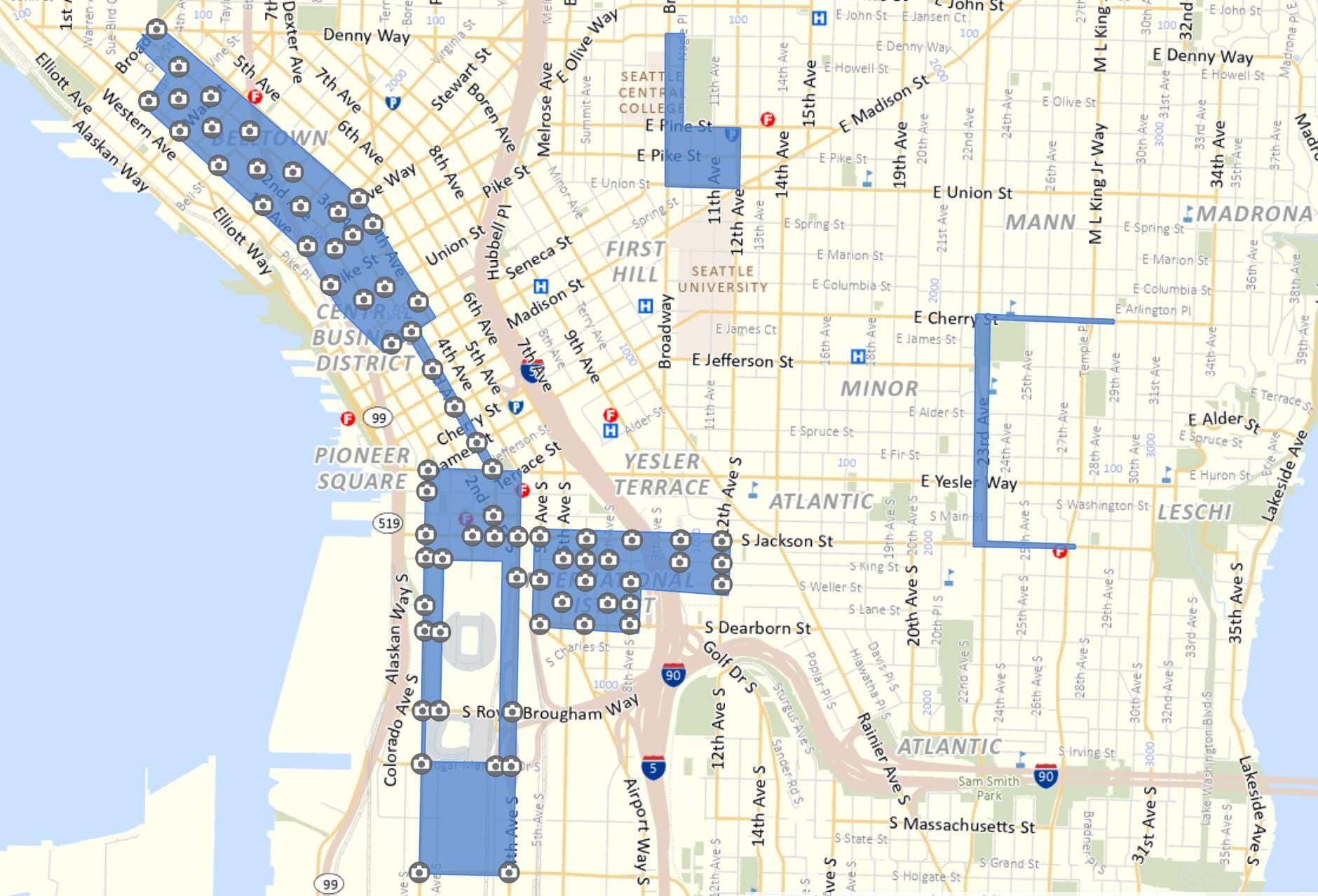
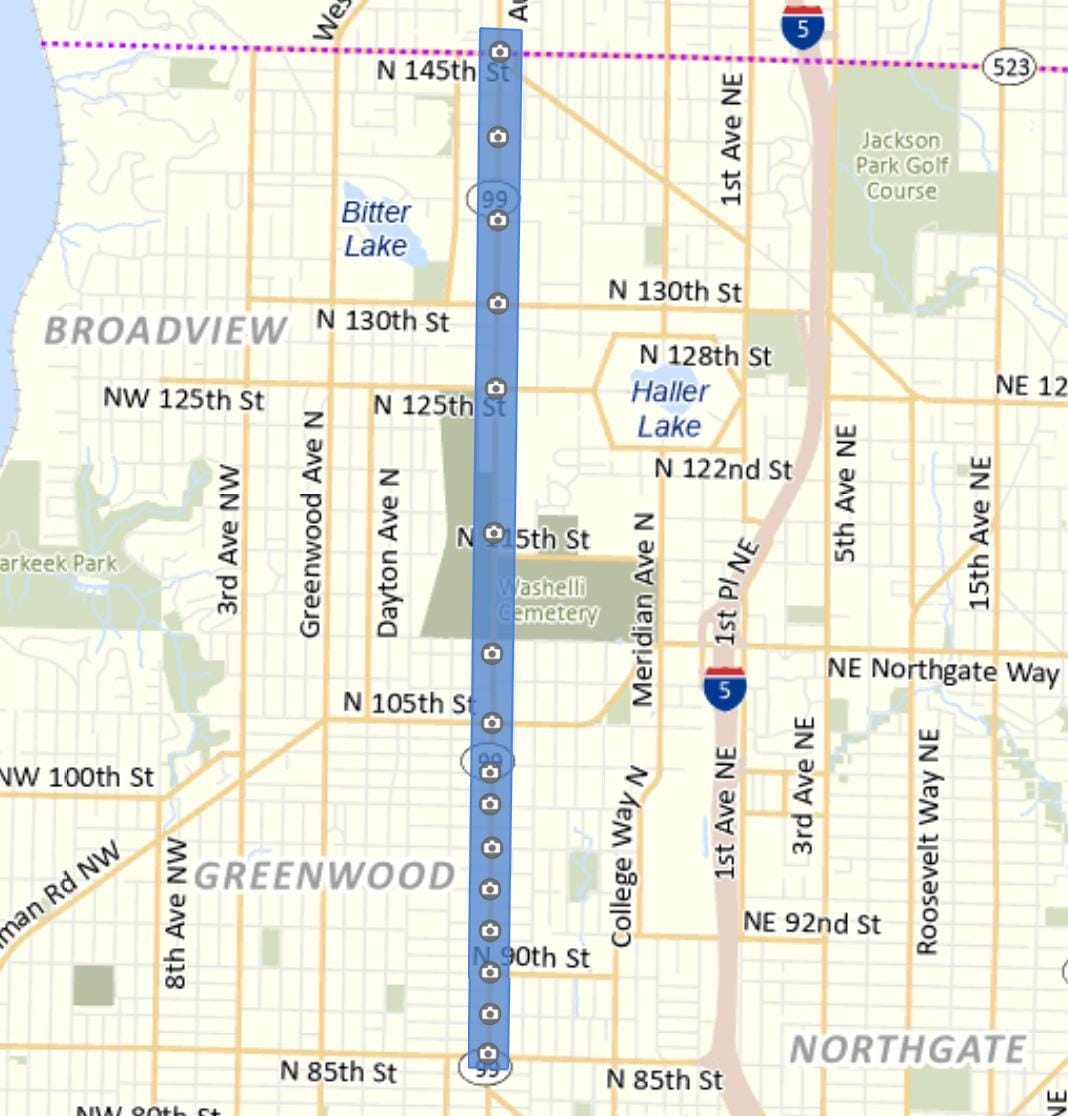
We have 62 cameras which are located in three specific kind of high crime neighborhoods of the city. There’s the North Aurora corridor, there’s the downtown business district concentrated around Third Ave, and then there’s the Chinatown International District. So those cameras feed into the Real Time Crime Center.
– Mayor Katie Wilson, Town Hall on Security & Surveillance hosted by the Seattle Channel March 30 2026 @00:15:312
what is Block The Shot?
nfz: You’re listening to CDFM on Hollow Earth Radio. In the room with me, I have Xochitl [Maykovich] and Melissa [Howard] of Our Seattle, an activist group who has questions for the mayor about the cameras that are being installed in Seattle as FIFA is ramping up and as the world falls apart, I suppose. So tell me about Our Seattle. How was it formed? For what mission? And how could people get involved with your organization if they’re interested?
Xochitl: So when Katie was elected I think a lot of people who worked really hard to get her elected had pretty high hopes, and when we saw that she wasn’t making any changes on surveillance, which was one of the things in her platform that she could take action on without City Council involvement because she could choose to not turn them on – the cameras – and I think a lot of folks were feeling pretty frustrated. And I started talking with folks who were former volunteers, and we decided to come together and push on her because we figured it’s clear the business community is organizing to push her more towards the center. And so we realized we have to push to hold her accountable to what she campaigned for.
nfz: Absolutely. So Our Seattle brands itself as a “grassroots movement to hold [Wilson] accountable for her campaign promises made at over 50,000 doors” in the Our Seattle Instagram bio. Did you campaign for Wilson? Were you the ones knocking on doors?
Xochitl: I was her field director.
Melissa Howard: And yes, I was a neighborhood captain knocking doors in Ballard and organizing other folks to come out to canvassing events and knock doors with me. And Xochitl was our fearless leader.
nfz: Was there a specific moment where you felt the need to start organizing?
Xochitl: I mean, I think some of it was just like how slow it was for her to even say anything about what she was going to do on surveillance. And I remember one of our former volunteers published an op-ed and there still wasn’t really any action or anything. And I was just like, what is going on?
Melissa: Yeah, the op-ed in the Seattle Times by Dan Howes, who, you know, I got to know volunteering for the campaign.
When our new mayor was campaigning last year, she spoke out against expanding video surveillance, citing Medicaid and Department of Licensing data that ICE had already exploited. However, since taking office almost a month ago, Mayor Wilson has taken no action to deactivate the system or even halt expansion, and has made no commitment to do so.
This is unacceptable. Community members have continued to urge the mayor and city council to halt the expansion of video surveillance in the name of keeping the people of Seattle safe from ICE’s terror.
…
A broad coalition of workers came together last year to take on the corporate political establishment and elect Katie Wilson to the mayor’s office. I’m calling on my fellow workers to hold the mayor to her word and and demand that she deny the Trump administration a powerful tool in his racist dragnet. Turn the damn cameras off.
– Dan Howes, Seattle Times, Feb. 9, 20263
Melissa: That really kind of brought me into this. I actually ran into him at another action and started talking with him about what can we do? You know, we went and knocked all these doors, 50,000, right Xochitl? and we talked to our neighbors about the vision that we wanna see for Seattle, and I don’t think that a growing surveillance state is reflective of what the community actually wants, especially right now with what you said about where we’re at globally, y’know, where we’re at in the US as we slide deeply into authoritarianism and fascism. It’s not the right approach, and that’s what drew me into the fold of trying to organize around this.
Instead of investing in surveillance invest in real public safety solutions. So, yank ‘em down. – Xochitl
nfz: Oftentimes, Our Seattle, in its advocacy, will advocate for taking down the surveillance cameras. However, the campaign that you’re running is called “Block the Shot” in reference to covering the cameras. And Katie Wilson often refers to alternative strategies such as masking or blurring parts of what the camera can see digitally or keeping the camera turned off unless and until there is some sort of incident report that is potentially related to the footage that would be on the camera. So, what is the goal of your movement?
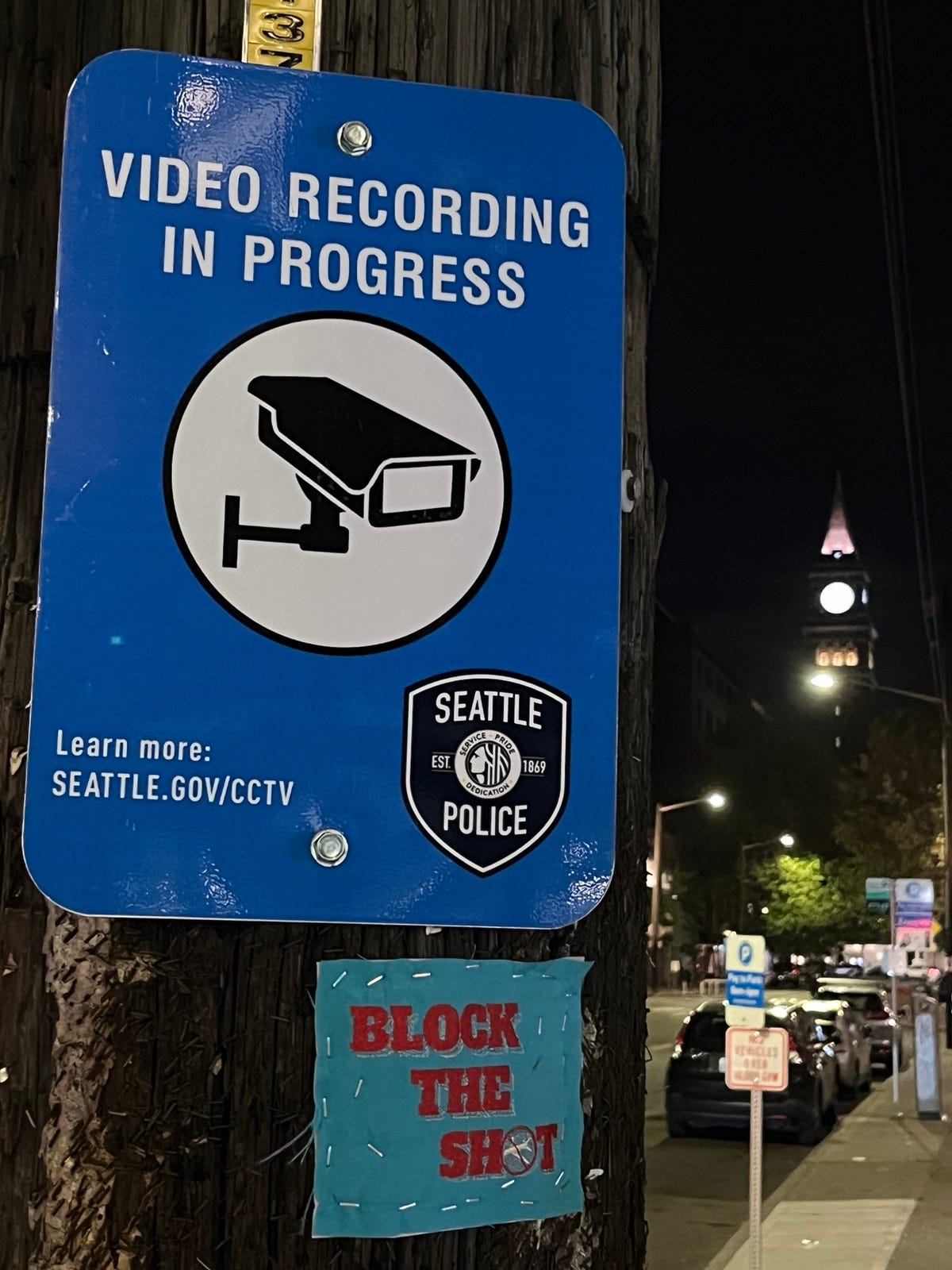
Melissa: The Block The Shot is a petition that we’re circulating. It’s really in response to the mayor’s response to surveillance when she said that she would be turning off select cameras and pausing the expansion for now. If she is in fact turning off the cameras, we can’t tell, you know? And you can’t tell by looking at them. And so that’s when we came up with the idea of this Block The Shot petition to try and call on the mayor to actually physically cover them so that we know when they are off. You know, she’s said that we have to install them in the stadium district due to FIFA and that they’re going to remain off unless there’s this credible threat. All of that sounds like honestly kind of a political nightmare waiting to happen, but we’re just saying, let’s cover the cameras then so we know when we’re actually being watched because like Xochitl said, you know, when people believe they’re being watched there’s a chilling effect, and we can’t tell that they’re off and we’re just supposed to take the city’s word for it.
I think also we saw that, you know, Stop Surveillance City did a FOIA request on the camera up at 105th and Aurora Avenue North and found that only one of those cameras— like, so each installed camera is actually five cameras in one installation and only one of those five had been turned off. Again, we have to just kind of trust that the city is actually doing what they say they’re doing. And that’s why we’re saying cover the cameras so that we actually know that you have turned them off.
nfz: Right. And again, that’s not—
Melissa: That’s a first step.
Xochitl: Yeah, because I think long term it’s about... Instead of investing in surveillance invest in real public safety solutions. So, yank ‘em down.
candidate Wilson vs. mayor Wilson
nfz: What was your understanding of Wilson’s platform in regards to surveillance cameras at the time? What were you told in the campaign offices to tell the electorate when you went to their doors?
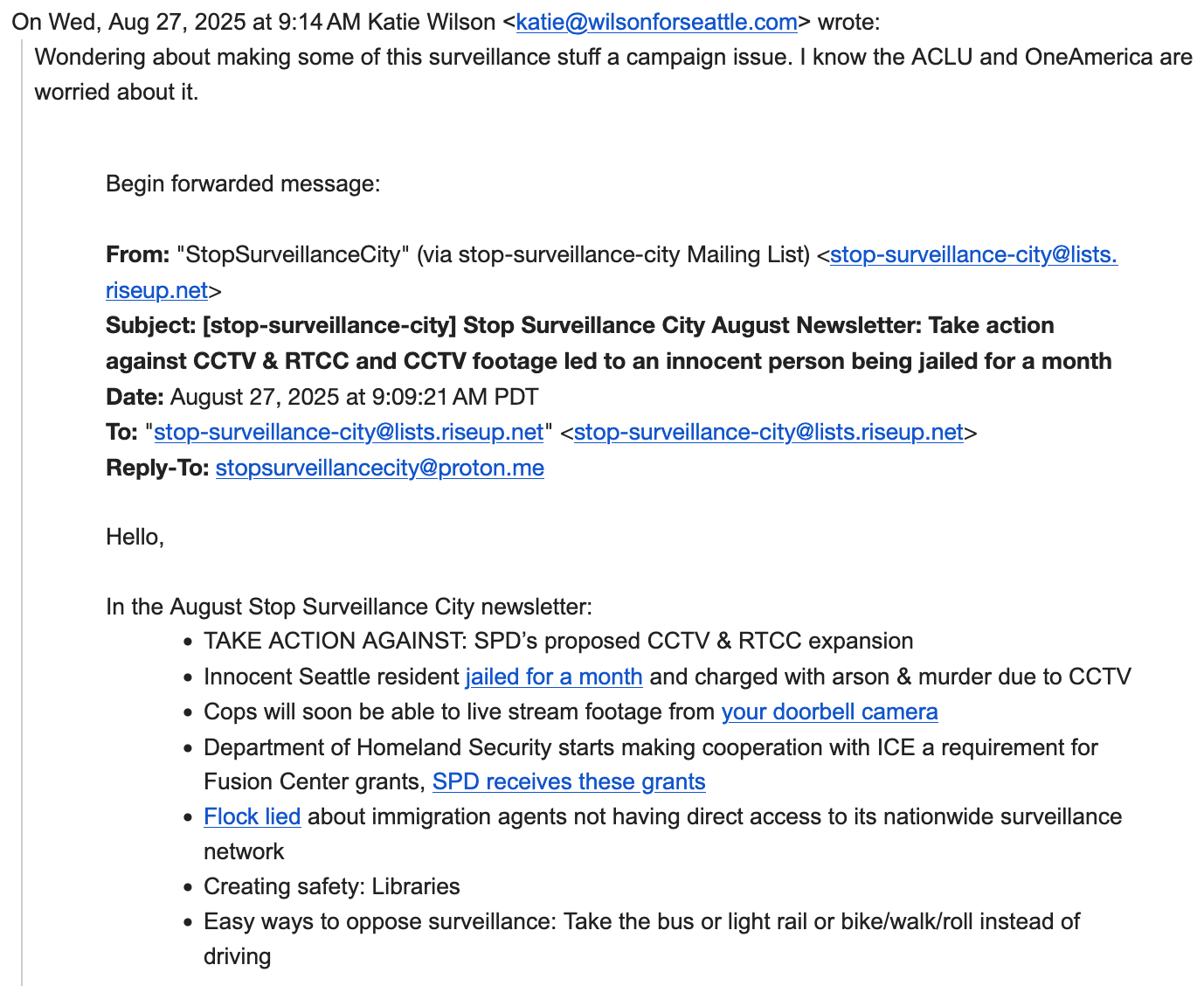
“Wondering about making some of this surveillance stuff a campaign issue. I know the ACLU and OneAmerica are worried about it” – Candidate Katie Wilson
Melissa: I know what she publicly stated on Instagram, which was a very strong statement against the surveillance expansion.
We urge City Councilmembers to stand with immigrant rights groups, civil rights advocates, and the city’s own Surveillance Advisory Working Group to reject the proposals before City Council to dramatically expand CCTV surveillance.
Turning on more cameras won’t magically make our neighborhoods safer. But it will certainly make our neighbors more vulnerable. As the Trump administration escalates its attacks on immigrants, trans people, and big cities in general, we need to prioritize safety, not surveillance.
…
The proposals before council Tuesday won’t make anyone safer, instead they’ll make us all more vulnerable.
– Candidate Katie Wilson via ig:@yourcityseattle4
Melissa: She came out and called on City Council to put an end to the expansion and spoke very strongly. I don’t know if she shared any additional things behind closed doors.
Xochitl: I’ll be real this is gonna... I don’t know. As I look back like I kind of feel like Katie didn’t necessarily have super strong convictions and I think that’s part of the problem that we have is like, I think that there were many things that she said that she was gonna do but she didn’t actually think deeply about and really interrogate within herself on, “Do I really believe this?”
I don’t think any of us can say we’re 100% sure of very much these days. – Katie Wilson
I have a clear memory of her, I still have that in my email somewhere like her forwarding me, “Oh the ACLU and One America have come out against surveillance. It seems like this would be a good campaign issue.” I was like, “Yeah.”
nfz: Like she decided in that moment?
Xochitl: “Yeah.”
There is no reason for SPD to obtain a cloud-based RTCC which would weaken state laws and endanger women, trans folks, and immigrant residents.
– Stop Surveillance City newsletter attachment “Dangerous Surveillance #3”5
Xochitl: For me it’s like, I mean there’s some level of like, my dad, even though my dad is fairly conservative my entire life he’s been someone who’s just always been... I feel like it’s kind of ingrained to me to be suspicious of something like government surveillance partially because of how I was raised. I mean my dad turns off the Wi-Fi if he’s not using it because he’s like, in case someone gets into it, which is like legit you know?
And so there’s certain things like I could be like, “yeah I’m against surveillance” because it’s just pretty ingrained in me. And like I spent some time in Hungary, and I was training political organizers. So I had to get registered with the government as a foreign agent this was when Orbán was in charge. It was like 2018. And I remember when I got off the plane, there was some military police that pulled me to the side. They searched my stuff. I had a government minder coming to all these trainings I was in. He didn’t speak English, but it was still just the fact that I was being watched was scary. And there was a person interpreting for me and he would censor me, like “you can’t say that.”
And I’m also convinced that my room was searched. I was gonna text my friend and tell him, “I’m pretty sure the government just searched my room,” and I felt kind of crazy, but I was really just it’s very unsettling. But then I was like, I don’t want to text him until I get out of Hungary, right?
So it’s like, the act of the government watching you you censor yourself and so for me I feel pretty strongly about this issue. But I think when I think back to the campaign and think about Katie, like, I just don’t think she’s ever really thought that deeply on many of the issues that she actually campaigned on. But I don’t think I realized it at the time, so...
We didn’t elect her to learn. We elected her to lead and take some principled stands on issues. – Xochitl
nfz: Yeah, you can correct me if I’m wrong, but in researching for this interview, I don’t know if I ever saw Katie say anything about the cameras other than that she specifically wants to limit their expansion, not that she was interested in turning off or removing any of the existing cameras.
One thing that I wouldn’t do is choose this moment to massively expand surveillance around our city.
– Candidate Katie Wilson, Seattle Mayoral Debate hosted by Rainier Avenue Radio September 18 2025 @00:27:256
Wilson: What I wouldn’t do as mayor is pass legislation that massively expands surveillance throughout our city, which is what our current mayor just did. This is legislation that will expand CCTV cameras that could potentially be taken control of by the Trump administration. And this is legislation that was opposed by immigrants rights groups, by civil liberties groups, and by the Member[s] of Color Caucus in the legislature. And I’ll quote from their letter:
‘This technology and technology and technology similar to it has recently been in the news for its failure to be meaningfully and consistently secured, leading to breaches that could result in sensitive data being shared by ICE and putting our immigrant and refugee communities at risk.’
So that is the kind of risk that I would not take.
– Candidate Katie Wilson, Seattle Mayoral Debate hosted by KING 5 October 3 2025 @00:48:557
Xochitl: I mean that’s what she says now but i think that’s splitting hairs. And I don’t think that anybody on the campaign including myself thought that’s where she was at. I think I would have interpreted as like, she’s responding to this bill but that at the core she was against surveillance. Not the sort of milquetoast sort of like, “I dunno, like I just need to like, learn a little more and...”
It’s always a work in progress, right? So we’ll do the best we can and then we’ll look for vulnerabilities and we’ll do, you know, an audit of how we’re doing and we’ll try to do better. And if there’s like a breach or something then that tells us we need to do better, right?
I’m pretty confident in the path that we’re on, and having seen kind of what I know now of how the system works and what we’re doing now to try to get more oversight and put better policies in place. But I can’t say that I’m 100% sure. I don’t think any of us can say we’re 100% sure of very much these days.
– Mayor Katie Wilson, Town Hall on Security & Surveillance hosted by the Seattle Channel March 30 2026 @01:16:50
Xochitl: We didn’t elect her to learn. We elected her to lead and take some principled stands on issues and actually get some change done, not just uphold the status quo.
Melissa: And when I was knocking doors, I was in Ballard mostly, and it was a mix of people that were clear supporters for Katie and then a lot of people that were very on the fence and not sure about Katie that were leaning Bruce [Harrell]. And I think it always came up, the national situation that we’re facing, that was a common talking point. I was proud to campaign for someone that wasn’t backed by corporate interests. That was something that I said at every single door. And I think that’s related to what we’re talking about here.
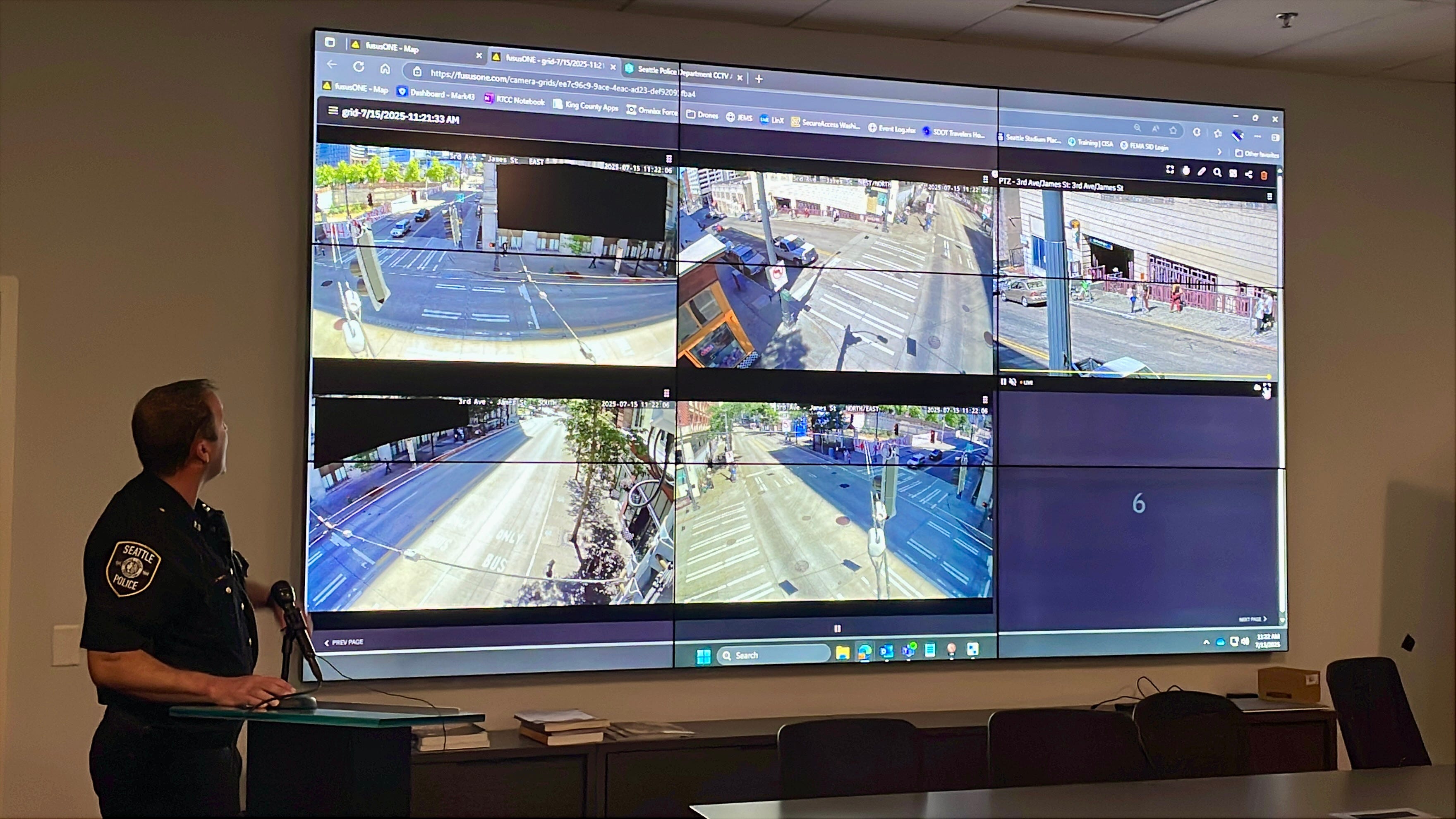
I think that a big reason why people are afraid of the cameras going up, and also the Real Time Crime Center and all of this growing surveillance state is the real fear that we have that this information can get into the hands of the wrong people, and that the federal government can use this against us. I mean, we have been targeted by the Trump administration. Mostly in language. We haven’t seen the same thing that so many other cities have seen in terms of like some kind of invasion.
But you know, I do think that people are worried about what could happen in the future, especially with the election coming with FIFA coming up. ICE is expected to have a big presence at FIFA. Axon has a big security contract for FIFA, actually. And it was ingrained in this, maybe not spoken about directly in the campaign, but her “Trump-Proof Seattle” platform came up a lot with people at the doors. Honestly, at every single door, I talked about that and why I felt that Katie was the better option to help us stand up to the potential federal overreach.
One of my first political acts in Seattle was joining the massive march for immigrants’ and workers’ rights on May 1, 2006. That’s the Seattle I believe in. We stand up for the most vulnerable. ...
We need city leaders who will step up to the challenge and defend against federal cuts and overreach. ...
I vow to protect our neighbors and defend Seattle’s status as a sanctuary city. ...
The City must play an active role in educating employers, institutions, and the public about what to do when ICE is at the door. Seattle’s Office of Immigrant and Refugee Affairs is stepping up, but with leadership from the Mayor’s Office we can do more. …
Seattle can’t be a true sanctuary city if ICE can access data about you through City policies and programs that could have been better designed. The City must also be mindful of any data collection related to individuals who travel to our state to access abortion services and gender-affirming care.
Revisit SPD’s Crime Prevention Technology pilot with an eye towards the storage and potential use of collected data and impacts on vulnerable populations.
Explore strengthening the city’s Surveillance Ordinance to ensure that any new technology is being considered with the seriousness it deserves, especially in its impacts on communities that may become targets of the federal administration.
– Candidate Katie Wilson’s “Trump-Proof Seattle” Platform8

suspicious connections between SPD, Axon, and the NYU Policing Project
nfz: So that leads a little into my next question. Xochitl, there’s a video of you speaking at a town hall with Mayor Wilson on, I believe it was March 30th, where you ask about Chief Barnes’ relationship with the NYU Policing Project.
Xochitl: PubliCola reported that you knew that Chief Barnes was on the advisory committee for the NYU Policing Project so how can the public have trust in this audit when there’s a very clear conflict of interest? And was there any competitive procurement for that contractor?
Wilson: So first of all Chief Barnes has stepped down from the board of NYU Policing. And we were not aware that he was going to be on the board when we were initially having conversations with them and again he has stepped down. We did talk with a number of like in figuring out who could do this audit, we talked with other potential auditors and NYU Policing was really the one that has the ability to do this audit.
Xochitl: So it wasn’t an RFP.
Wilson: No, it was not an RFP because we wanted to do it fast. And so if we want to do something in a timely manner—
Xochitl: Maybe breaking city laws there.
Wilson: We’re pretty careful not to break city laws.
Xochitl: Well, just so you know, your comms person was quoted in PubliCola as saying that you knew he was on the board.
– Town Hall on Security & Surveillance hosted by the Seattle Channel March 30 2026 @01:08:02
nfz: On March 24, 2026, in an article titled, “What is the NYU Policing Project and Why Did the Police Chief Resign from Their Board,” Erica C. Barnett writes,
We reached out to the mayor’s office about the potential conflict of interest first thing Monday morning. Initially, a spokesman for Wilson told PubliCola that the “mayor is aware of the chief serving on that board” but did not indicate she had any concerns.
– Erica C. Barnett op-ed “What Is the NYU Policing Project, and Why Did the Police Chief Resign from their Board?” for PubliCola, March 24, 20269
So it feels like the thumb is on the scale if you’re relying on an entity to give you information about the data security and a legal analysis regarding surveillance if the person who’s the biggest proponent of it in the administration was on their advisory board. – Xochitl
Wilson: We knew that he was on the board when?
Xochitl: That you knew that he was on the board. I mean Erica’s here...
Wilson: We found somewhere during this process that he was going to be on the board.
Xochitl: And so you still went forward with contracting with them, because I think under any ethics—
Wilson: Again he has stepped down from the board.
– Town Hall on Security & Surveillance hosted by the Seattle Channel March 30 2026 @01:10:47
nfz: What is the NYU Policing Project? What is Axon? And what is that relationship, and why do you describe it as a conflict of interest?
Melissa: Well Axon was formerly known as TASER International. They are the maker of the TASER, and they supply TASERs to our police as well as pretty much every police department in the country. All over, globally really.
They also then pivoted to body cameras when police body cameras were being pushed roughly what, ten years ago? So they are, y’know along with Motorola, they’re basically the leading provider of police body cameras.
They’ve now expanded even further, and actually they have a local office here in Seattle. They specifically located that office here for this pivot to more of a technology company. They’re basically trying to build what they call an “operating system” for policing. Integrating body cameras, the surveillance cameras, as well as even some private camera footage as well into this Real Time Crime Center that, despite what the mayor keeps saying around there not being AI facial recognition technology, the platform is totally driven with AI. It’s using AI technologies throughout. I know Xochitl can probably speak more to some of that.
Xochitl: Axon also runs evidence.com which is where all the video footage gets uploaded and that’s what gets used in court. And so I have a friend who is a public defender, and he talked about how on the platform it can tell you how many people are in a video. It can tell you, like if you want to find all the places where your face shows up, it can do that.
It’s using a lot of this technology and I think that the technology has advanced so much and so fast that I don’t think we’ve had the time to really dig in and think about what is its accuracy? And what are the implications of using it? And when you’re talking about using it in a criminal matter, you’re talking about taking away someone’s liberty.
So it’s a transparency problem. How are we to trust this organization when we don’t really know who’s behind it? – Melissa
nfz: Right, and Chief Barnes?
Xochitl: Yeah, well, I think the conflict of interest is the fact that Chief Barnes used to be on the advisory board for the NYU Policing Project, which is affiliated with NYU’s law school, and they do a lot of policy work and similar things like that. But the fact that they’re so tightly connected to the police I think raises a lot of questions. And one of the issues is that what the mayor constantly is saying is like, “Well we’re doing this study to really, you know, study the risk of surveillance.”
One, you don’t need to do that study. Public records laws are pretty straightforward, and you can do a public records request and get video. The data is not secure. I think anyone who has any experience of getting emails or getting letters of, “sorry, there’s a data hack, so some of your data got exposed into something.” I think we’re kind of numb to that kind of thing. So the idea that this data is secure is... It’s just not true. So we don’t need to do any study on that.
But the fact that Chief Barnes, who is a very strong supporter of surveillance, was on the advisory board and didn’t step down until either right when PubliCola reported on it or right before, and they got a no bid contract. So there was no sort of open RFP of let’s find a consultant who could do this type of study in fair, neutral way. I learned that somebody associated with Stop Surveillance [City] actually sent the mayor’s office like 13 or 14 potential professional firms with a lot of experience that could do like an analysis of the data security. UW Law School’s down the street. They could do an analysis of the legal aspects of this. And also, they probably have a better understanding of Washington State law compared to New York.
So it feels like the thumb is on the scale if you’re relying on an entity to give you information about the data security and a legal analysis regarding surveillance if the person who’s the biggest proponent of it in the administration was on their advisory board.
nfz: In one of your speeches that you’ve posted to the Our Seattle account, Melissa, you draw a connection between the funders of the NYU Policing Project and the investors in Axon.
Who has funded the NYU Policing Project? The Charles Koch Foundation and the Charles and Lynn Schusterman Family Philanthropies, both known for funding extreme right-wing causes. Mark43, another surveillance and police tech company. And Axon, the very company providing our surveillance cameras, has also been in this list of funders. How can we trust the NYU Policing Project with an unbiased audit when this is who pays their salaries?
– Melissa speaking outside Seattle City Hall via ig:@our.seattle, March 24 2026 @03:3010
Melissa: So at one point, Axon was at one point listed as a funder in the past. That’s no longer appearing on the site.11

Melissa: If the NYU Policing Project wants to be transparent and tell us exactly where all of their funding’s coming from, I think we could have a lot more trust in it. Right now they’re hiding behind, all their funding is lumped in with all the funding that goes to NYU, and we can’t see who is funding the Policing Project in particular.
So it’s a transparency problem. How are we to trust this organization when we don’t really know who’s behind it?
security by obscurity
Why? Because they understand having that data is too risky. Just having it, period. It’s too risky. Because you can’t protect against mistakes. – Xochitl
Florangela Davila: Why should we open the door to this technology in the first place?
Wilson: I mean I think it really is that balance between the again the benefits that the system is providing versus what we believe the risks to be. And so the goal here is to really assess what those risks are and then take steps to minimize them and them, and then we have to balance that against what we believe the benefits to be and I mean there’s no other... that’s how we make policy, right? And now yeah, I mean we could decide the risks are too great and then shut the cameras off, right?
– Mayor Katie Wilson, Town Hall on Security & Surveillance hosted by the Seattle Channel March 30 2026 @00:20:52
nfz: According to what she has learned so far she says,
The footage is stored like on site in the camera so it’s not automatically uploaded anywhere. On site in the cameras for five days after which it’s erased. But once footage is called up in response to an incident it does get uploaded into evidence.com. And so this is one of the points which is a concern for me because those servers are in other states and we don’t necessarily know what... y’know, how secure is that data once it’s uploaded to those servers that’s no longer protected necessarily by Washington State’s kind of privacy laws? So this is one reason why we’re doing this audit.
And another thing that we learned in visiting the RTCC, they don’t share data with other law enforcement agencies. But one thing we learned is that while that is their practice, when we checked, that’s not actually codified as SPD policy. So the other thing that we’re doing over the next few months in addition to this audit is trying to codify some of these good practices into actual policy so that it’s not just dependent on the judgement of whoever is running the RTCC. Another things is, there are cameras where there might be like an apartment building in view. There’s masking so that you can’t actually see like peoples’ balconies or peoples’ windows or whatever.
And there was one camera which was near a reproductive healthcare and gender-affirming care facility. That’s the one that we are turning off. But there was also masking in place on that. And supposedly we are told that masking can’t be undone. Like if federal authorities came in, you can’t unwind that masking. But that’s something that we want this security audit to look at. Is that actually the case? But the masking, I believe, is another thing which is a good practice but which was not sufficiently codified in policy.
– Mayor Katie Wilson, Town Hall on Security & Surveillance hosted by the Seattle Channel March 30 2026 @00:15:41
nfz: Is this a sufficient approach to protecting Seattle residents? Do you believe her when she says it’s a possibility that her audit could result in shutting off the cameras? Is there some level of oversight and restriction upon the CCTV/RTCC infrastructure that would reduce the risks sufficiently to make them worth having?
Xochitl: So a couple things. One, SPD policy doesn’t really matter in this context because you can get the data in two ways. A public records request, which SPD policy can’t trump, or a court order. So you can say that you’re not going to voluntarily give data to another police agency but they can just... you can just send any government employee an email saying, “Please provide me this record,” and that is a public records request in which they are supposed to respond within five days, a good faith estimate on how long it will take them to get you that record. So that is just all nonsense there.
I think the second thing is a court order. Is the mayor saying that we’re just going to become a city where we’re just going to ignore court orders? I think our entire democratic system relies on the rule of law, so I don’t really think that’s a feasible alternative.
I know King County Department of Community and Human Services, they don’t collect immigration status at all. Why? Because they understand having that data is too risky. Just having it, period. It’s too risky. Because you can’t protect against mistakes. Someone could make just an error or an accident.
I used to work for King County. During the rental assistance program, I was sending out a mass email. I made a mistake on the spreadsheet and I accidentally... I was copying and pasting like the names and the address and we’re gonna do this mail merge. And I accidentally had the names and the emails wrong on the wrong rows, so I sent an email out where it was like, “Dear Melissa, here’s the status of your rental application,” but it should have been “Dear Bob” or whatever. And that was just a good faith mistake where I accidentally put out the wrong names connected to an email.
That was just a spreadsheet mistake. Ultimately you know I messed up people’s first names. I don’t think it was like the end of the world, but what if I accidentally emailed out an unredacted list of something right? That can happen, and so our local governments have already made the decision that, “Oh well having this immigration status data is too risky so we’re not going to collect it.” I would argue that having video footage of people’s lives—
Because like ultimately it’s... even the masking, it’s like, okay, you mask somebody’s balcony. Now, I’m not tech savvy enough to know if it’s truly possible to be undone. I am very skeptical. I don’t personally believe that that’s possible.
I literally do not believe for a second that SPD has cybersecurity experts like myself operating there asking these questions because if they did, Katie Wilson would not have mealy-mouthed answers. – AJ
To learn more about data security, I reached out to my friend AJ, a former cybersecurity engineer for Nordstrom and antifascist activist known for his YouTube channel, SquidTips, to give his perspective.
AJ: At Nordstrom, so as a cybersecurity engineer, I focused on the endpoint security, but I joined a, we had a security review team and basically every project that needed production resources, you had to go through this team, you had to do a presentation, and through that, there was a project to review Axon. They wanted to utilize the parking lot cameras and they wanted to put body cams on security guards.
And so they wanted to put it in a single store and see how it did, if it helped them reduce theft. They basically wanted it to catch people they have some people who are coming in and out they just want to increase prosecutions, right? Like that’s kind of the thing with with cameras is that in these settings is that they are very good at catching like retail... it’s for it’s for property crime and theft.
But yeah so because I’ve got a YouTube channel I’m a... nobody really else had any like video, audio/video expertise expertise in like what the laws are around like recording people in the country in different States. And so, yeah, I got put onto that project. So I actually oversaw Axon and was engaged with Axon like sales reps directly and trying to get questions answered for that security review. Yeah. So like, I actually know exactly how Axon does these things. So that was why I reached out to the city. I said, “Not only do I have expertise in body cameras and video footage and these types of laws and technologies, like I’ve actually worked with the vendor.”
Once it’s on their servers, we have no control. And that is the core problem. – AJ
So at Nordstrom when I was part of that security review team and I talked to Axon, we would hand them a gigantic questionnaire of questions like “what is your data retention policies? Where is that data stored? Which service providers? What regions is it stored in? What GDPR (General Data Protection Regulation), what PCIs (Payment Card Industry Data Security Standard)? SOC 2 (System and Organization Controls 2)? Which of these certifications do you comply to? These are foundational questions before you ask before you ever buy a product like in a professional cybersecurity environment.
Because yeah, I mean that screen can be done in software, and you can have it as a composite layer on top of the image, but yeah, is it controlled by SPD? Do they design that? Does Axon design that? Where is the raw video? Where is the composite?
Prove to us that it can’t be done. And that is a lot of security is proving can be done. I literally do not believe for a second that SPD has cybersecurity experts like myself operating there asking these questions because if they did, Katie Wilson would not have mealy-mouthed answers. She would have very clear answers because they would be trying to prepare her for this, to be able to speak clearly to it.
And you’re totally right to be sensitive and sense that and say, “That’s a problem there.”
Here’s the thing:
Our data, I guarantee, if it goes up to Axon’s data cloud, that is going to Microsoft servers. Microsoft servers are not only used with Israel, it is making Microsoft’s facial recognition technology, AI technologies better, and people don’t want that either.
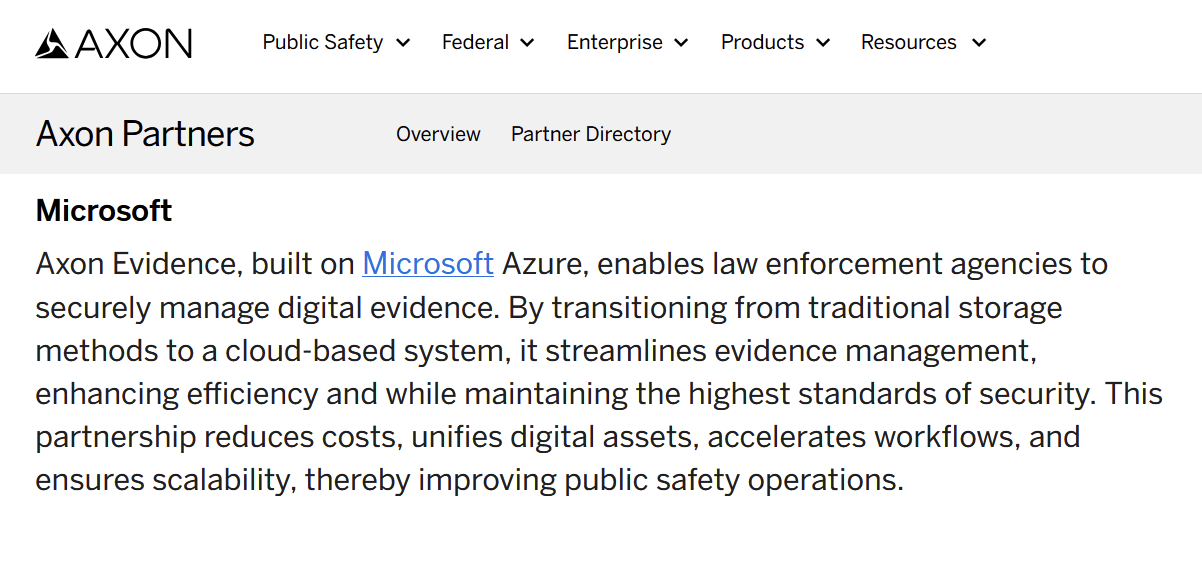
And to tell Axon, “You can’t do that” – that’s like a hard line. They’re gonna push and fight that at every fucking second. So just like this here, they will push and fight – “No, no, no, you can’t, we’re just gonna... Best practice, trust us.”
Once it’s on their servers, we have no control. And that is the core problem.
Axon is not a trustworthy company, just like Flock is not a trustworthy company. In my experience talking with them, it was very difficult to get them to answer all of these questions in the same way we’re getting it here. They want to hide stuff.
There’s this concept called “security by obscurity,” right? “If I hide my wireless network, if I tell it not to broadcast so it’s just not visible, hey, then people can’t connect to it. I don’t need a password.” People can use technology in order to see the radio signal – “Ok, there’s no password...” – it’s not real security.
And the same thing is true for all of the secrecy that SPD and Axon and them do. All of these security companies. And, “We can’t tell you at all how the layering shit works that’s a proprietary technology that if we give it away then the bad guys will be able to...”
At some point you’re taking the raw video and you’re slapping a black square over it. And then from that point once the pixels have been overwritten, that the pixels say in a 1080p or whatever video format, that’s, yeah, that’s what the pixels are, they’re black. But prior to that moment, you are going to take the raw footage to Axon’s cloud, and from there absolutely the federal government has access to it.
It all goes back to, who is the steward of these things? … you should be able to be very transparent about your security because when you’re transparent, you are confident it can’t be subverted. – AJ
nfz: Do you know specifically at what point in the technological chain the masking is done? Or is that the proprietary secret they don’t tell you where it happens?
AJ: I cannot perfectly tell you the answer. My interpretation from all of the information I’ve gotten is that Axon’s cloud system is a, it’s a whole software as a service. So not only does it handle the video itself, but it’s also like an editing tool. You know, it allows them to clip stuff out, allows them to sensor certain things, certain data.
And so my guess is that... It seems like SPD contracts Axon out to then, whenever... okay, “We need body cam for this, it’s going to go into this context, it’s going to be a publicly released, so we need all this stuff masked over.” So that is when it is done is at the level of that cloud. Meaning that we’re not sending them a masked version. That is what would have to happen. SPD would have to mask it and then deliver it to Axon for whatever their cloud service... And I guarantee you that is not happening.
It all goes back to, who is the steward of these things? Without cybersecurity professionals that are confident and capable and transparent... you should be able to be very transparent about your security because when you’re transparent, you are confident it can’t be subverted.
When you are hiding things, that tells me you are either incompetent, and you just don’t want people to find out the really obvious ways around your security, or you’re fucking corrupt, and you want to hide your bullshit. That’s what it tells me.
And if we’re supposed to trust some big institution to come in and audit it in a dark room somewhere and then like tell us, “Oh, yeah, it’s safe...” It’s just that it’s not trustworthy and it’s not transparent and it’s all the things that I think Americans are quite frankly very tired of. – Melissa
release the files
Xochitl: I think the reality is it’s not just about protecting someone’s balcony. I don’t think that people should know my schedule. They shouldn’t know when I go walk my dog. They shouldn’t know when I go take my trash out or any of that, right? And that’s ultimately what you can be collecting. Like you’re tracking someone’s movements and that’s what ICE is using to get people, right?
So it’s not like it’s a crazy thing to think about that it creates risk. It does, and I also think that we should be skeptical enough of technology to understand that anything they say, that it can be for sure not abused in this way, is like not true.
So I don’t know, Melissa you probably know more but...
Melissa: I want to see like an architecture, or whatever they’re, like however this is architected because, is it in fact true that like are these on-premise servers that the City of Seattle is operating? We need to know that, you know? And if the mayor’s making claims like that, it should be easy to show how this system’s set up and honestly that’s what I would love to see from this audit.
I don’t know that I can trust the NYU Policing Project for what I’ve said about their lack of transparency and who’s funding them, who they really are, also their tight, close-knit relationship with police departments across the country. I would love to see someone do that audit and actually show us exactly how this data is moving through these different places and spaces. But I don’t believe that even for a second either.
And then lastly with the masking, I mean, there’s still an original file. What are they doing with this? Again, that’s something that I would want to see like a technical document. And I think that should be made public so that it can be scrutinized by experts who can weigh in on that. And I don’t believe Axon’s gonna release that implementation.
This kind of system, if we’re gonna have it, which I don’t think we should because of all the risk we’ve outlined, it should be like an open-source system that we can actually scrutinize and look into, not something that’s closed and proprietary and that we have no insight into how it actually works. And if we’re supposed to trust some big institution to come in and audit it in a dark room somewhere and then like tell us, “Oh, yeah, it’s safe...” It’s just that it’s not trustworthy and it’s not transparent and it’s all the things that I think Americans are quite frankly very tired of.
We’ve talked about the Block the Shot petition and basically we’re just calling on Mayor Wilson to make it very clear that she has in fact turned the cameras off that she said that she’s turned off. We want physical barriers over the cameras to show that they’re telling the truth and the cameras are in fact not watching us.
So you can see more information about our Block the Shot petition on our Instagram page, and definitely please sign if you’re compelled by this issue. You can also get there directly by going to change.org/block-the-shot. Links in the bio.
nfz: Don’t forget to like and subscribe.
Xochitl: Yeah, follow us on Instagram. We’re planning a picnic in June just to come together and just connect, build a little bit of community.
So follow us on Instagram @our.seattle to get the updates.
nfz: This has been nfz broadcasting CDFM for Hollow Earth Radio.
To follow this series as it is released, follow me on Instagram @cellar.door.studios or on Substack at nfzemb.substack.com
“Virtual Town Hall with Mayor Wilson (4/7/2026),” posted April 8, 2026, by Community Not Cameras Coalition, YouTube, 1 hour, 39 sec., youtu.be/cd2NfA42gwk?si=lWVBMesre7AapWHg&t=2180
“Mayor Wilson Town Hall on Security & Surveillance.” posted March 30, 2026, by Seattle Channel, 1 hour, 29 min, 10 sec., youtu.be/JLyvxHBFYdI?si=TMY02Xuf8T4PXEhh&t=4611
Dan Howes, “Mayor Wilson should halt use, expansion of CCTV in Seattle.” The Seattle Times, February 9, 2026. https://www.seattletimes.com/opinion/mayor-wilson-should-halt-use-expansion-of-cctv-in-seattle/
Katie Wilson (@yourcityseattle), Statement on City Council’s Proposal to Dramatically Expand Surveillance of Seattle Residents, September 9, 2025, instagram.com/p/DOY5v0kkWi1/
“Dangerous Surveillance #3: The City is considering a Real Time Crime Center (RTCC) software, such as Fusus.” Stop Surveillance City, August 27, 2025. https://docs.google.com/document/d/14EhNiDMb7M8Z7TafyZsbxGOfdelDOGzRYxZNd3biwIE/edit?tab=t.0
“Seattle Mayor Debate: Bruce Harrell vs. Katie Wilson.” streamed live September 18, 2025, by Rainier Avenue Radio, YouTube, 1 hour, 34 min, 14 sec., youtube.com/live/Y1SQQn3J7Pc?si=VhJVtqI0fvhTxXZy&t=1645
“KING 5’s complete Seattle mayoral debate.” posted October 3, 2025, by KING 5 Seattle, YouTube, 54 min., 6 sec., youtu.be/CIIvfVa4fuY?si=WohUOqrTyVH9mQZH&t=2935
“Trump-Proof Seattle,” Katie Wilson For Mayor, accessed May 28, 2026, https://www.wilsonforseattle.com/trumpproof
Erica C. Barnett. “What Is the NYU Policing Project, and Why Did the Police Chief Resign from their Board?” PubliCola, March 24, 2026. https://publicola.com/2026/03/24/what-is-the-nyu-policing-project-and-why-did-the-police-chief-resign-from-their-board/
Our Seattle (@our.seattle), Katie campaign volunteer Melissa speaks outside Seattle City Hall before delivering letter to @mayorofseattle, March 24, 2026, instagram.com/p/DWSLuAGAVh3/
“Our Partners & Funders,” NYU Policing Project, accessed June 28, 2022 [via Wayback Machine], https://web.archive.org/web/20220628223156/https://www.policingproject.org/our-partners


